Court Marriage

Court Marriage Syatem
Court Marriage in Nepal
1. Court Marriage in Nepal
Court marriage typically refers to a legal marriage ceremony
performed by a Government Official, such as a judge, magistrate, or a
registrar, instead of a religious ceremony conducted by a clergy member. Here’s
a general outline of what court marriage involves:
2. Legal Requirements: Before getting married in court, couples usually need to fulfill
certain legal requirements according to the respective country such as
providing identification, proof of age, residence, and sometimes a marriage
license or a notice of intended marriage.
3. Booking an Appointment: Couples typically need to schedule an appointment with the court
where they intend to get married. Different jurisdictions may have varying
procedures and waiting periods. Before being married, a couple usually needs to
make an appointment with the court. Procedures and waiting times may differ
throughout jurisdictions.
4. Witnesses: Witnesses must be present during the marriage ceremony in
various jurisdictions. Depending on the locality, the quantity of witnesses and
their criteria (age, couple relationship, etc.) may change
5. Ceremony: The couple and the official (a judge, magistrate, or registrar)
participate in the ceremony. After confirming the couple's identification and
reading any formal declarations or vows, the official will declare them married.
6. Process: The ceremony itself is usually involves the couple and the
official (judge, magistrate, registrar). The official will verify identities,
read legal statements or vows, and then pronounce the couple married.
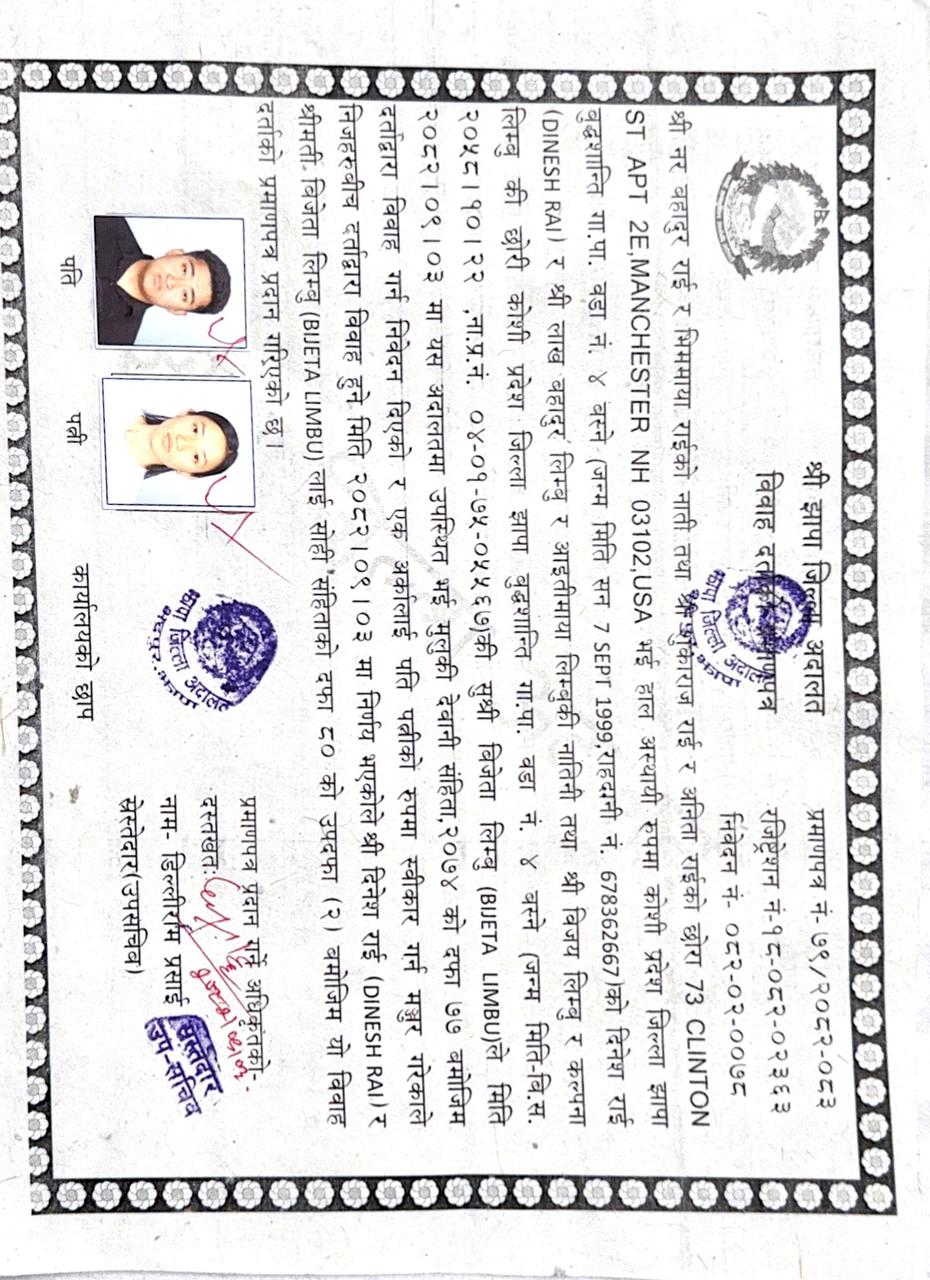
7. Legal Documentation: After the ceremony, the official signs and provide a marriage
certificate or license, which legally records the marriage. This document is
usually filed with the appropriate government office to officially register the
marriage.
8. Legal Benefits: Marriage conducted through court typically grants the same legal
benefits and rights as marriages conducted through religious ceremonies,
including rights related to inheritance, taxes, healthcare decisions, etc.
9. Discretion: Court marriages offer couples the option to keep their marriage
private if they wish to avoid family or societal pressures or prefer a low-key
celebration.
Court marriages are often chosen by couples for various reasons,
including simplicity, convenience, legal considerations, or personal beliefs.
The process can vary based on local laws and regulations, so it’s important for
couples to check with their local court or registrar’s office for specific
requirements and procedures.
Court Marriage Merits
Court marriage offers several benefits, which includes the
following:
1. Efficiency and Simplicity: Compared to traditional
ceremonies, courts marriages are frequently faster and include fewer formality
and paperwork.
2. Legal Recognition: Court marriages are legally
recognized under the law, providing a solid legal foundation for the
relationship. It bides couple equal rights and responsibility as prescribed by
law.
3. Privacy: In order to guarantee privacy and minimize the
need for luxurious ceremonies, court marriages are performed in the presence of
a marriage registrar or judge and a few numbers of witnesses.
4. Social Acceptance: As a contemporary and uncomplicated
alternative to customary weddings, court marriages are becoming more and more
socially acceptable.
5. Inter-religious and Inter-caste Marriages: Court marriages
can help people from various castes or religions get married and overcome
societal hurdles.
6. Inter-religious and Inter-caste Marriages: Court marriages
can help people from various castes or religions get married and overcome
societal hurdles.
7. Protection of Rights: Marital laws grant both
partners certain legal benefits and rights, such as shared property ownership,
inheritance rights, and other advantages.
8. Cost-effective: Since court marriages require fewer
personal costs for ceremonies and customs, they are typically less expensive
than traditional weddings.
9. Less Formalities: Court marriages, as compared to
traditional marriages, usually ask for less rituals and traditions, with a
primary emphasis on legal obligations.
10. Avoiding Luxuriousness and Dowry: Court marriages can
assist in avoiding the burden of dowry demands and the ostentatious spending
that come with traditional rituals.
11. International Recognition: Court marriages are recognized
all over the world, which is advantageous for couples who intend to live or
visit elsewhere.
12. All things considered, court marriages provide a
reasonable, morally upright, and frequently more affordable alternative for
couples who wish to formally bind their union without the complications and
costs of traditional weddings.
Destination marriage
A "destination marriage" is a wedding in which the
couple and their guests travel to a different location for the marriage
ceremony and celebration than their hometown or customary place of residence.
It's growing more and more common for couples who wish to pick an attractive or
significant location that means something to them, or who want to marry while
on vacation.
When organizing a destination wedding, factors like following are
to be considered:
Location: Whether it's a beach resort, touristic place, historic
city, tropical island, or rural place, pick a place that fulfills your concept.
Legalities: Recognizing the various legal requirements in your
chosen location before getting married
Personal Information:
Full name, Date of birth, Address, Nationality, Occupation,
Marital status (single, divorced, widowed)
Details of the Spouse:
Full name, Date of birth, Address, Nationality, Occupation,
Marital status
Witness Information:
Full name, Permanent Address, Relationship to either party
Documents Required: You may need to submit copies of certain documents with the
certification from notary public officer such as:
Citizenship certificates, Passport or identification, Proof of
residence, Affidavits stating marital status and consent (if applicable)
Declaration of Consent: Both parties typically sign a declaration affirming their
willingness to marry each other.
Legal Requirements:
Depending on your jurisdiction, there may be additional legal
requirements or questions specific to that court's procedures.
It's important to check with the court or registrar where you plan to conduct
the marriage for any specific requirements or additional paperwork they may
need. The questionnaire or information required can vary slightly based on
local laws and regulations.
Why Nepal
Nepal is safety and cheap for foreigners. People are friendly here.
Documents for Court Marriage in Nepal – For Foreigners
The following documents are to be prepared for getting court
marriage by any foreigner in Nepal
No Objection certificate (NOC) / CNI
If you're going overseas to get married, you may need a
Certificate of No Impediment to Marriage (CNI). Authorities overseas may ask
for a CNI to prove you're free to marry. The Department of Foreign Affairs can
issue CNIs.
No Objection certificate (NOC) is an
essential document for foreigners to get married. It is a document which proves your current
status as single in case
you want to get married abroad. The relevance of the document to the marriage
process is to establish whether there are obstructions preventing you from
getting married. This can range from committed offences to an individual
objecting to the proposed marriage.
It is a certificate that states an unmarried and eligibility of
marriage for foreigners in Nepal. NOC is taken from the respective embassy
located in Nepal. If there is no embassy in the respective country, foreigners
should contact the consulate office located in Nepal.
Foreigners should contact to their embassy situated in Nepal prior
to coming to Nepal. Foreigners should be well aware of the required documents
to bring from their home country stating their unmarried and eligibility status
before coming to Nepal for court marriage. It is appropriate to make
appointments with the concerned embassy in Nepal through an online appointment
system if it is required.
Affidavit of Eligibility to Marry
Nepali law requires foreign citizens who marry in Nepal to present
an “Affidavit of Eligibility to Marry.” Lawful permanent residents (‘Green
Card’ holders) who do not have a Nepali citizenship card may also find form
useful. The affidavit is available from the Embassy by scheduling an
online appointment. Pay the fee and present your passport or Green Card at
the time of the appointment.
We recommend you issue the affidavit shortly before your marriage
ceremony and register your marriage soon later. Court official may ask you
to get a new affidavit, if you wait more 15 days from the day the affidavit was
signed by a Consular Officer/ embassy.
Individuals who have been previously married may be asked to
present a legal divorce verdict or their spouse’s death certificate. You
also need to submit a copy of the marriage law of the state you reside in.
Recent Articles
Court Marriage Certificate
Dec 25, 2025
Notary: Letter to Immigration
Dec 25, 2025
Translation: Human Trafficking
Dec 12, 2025
Translation: Contract
Dec 11, 2025