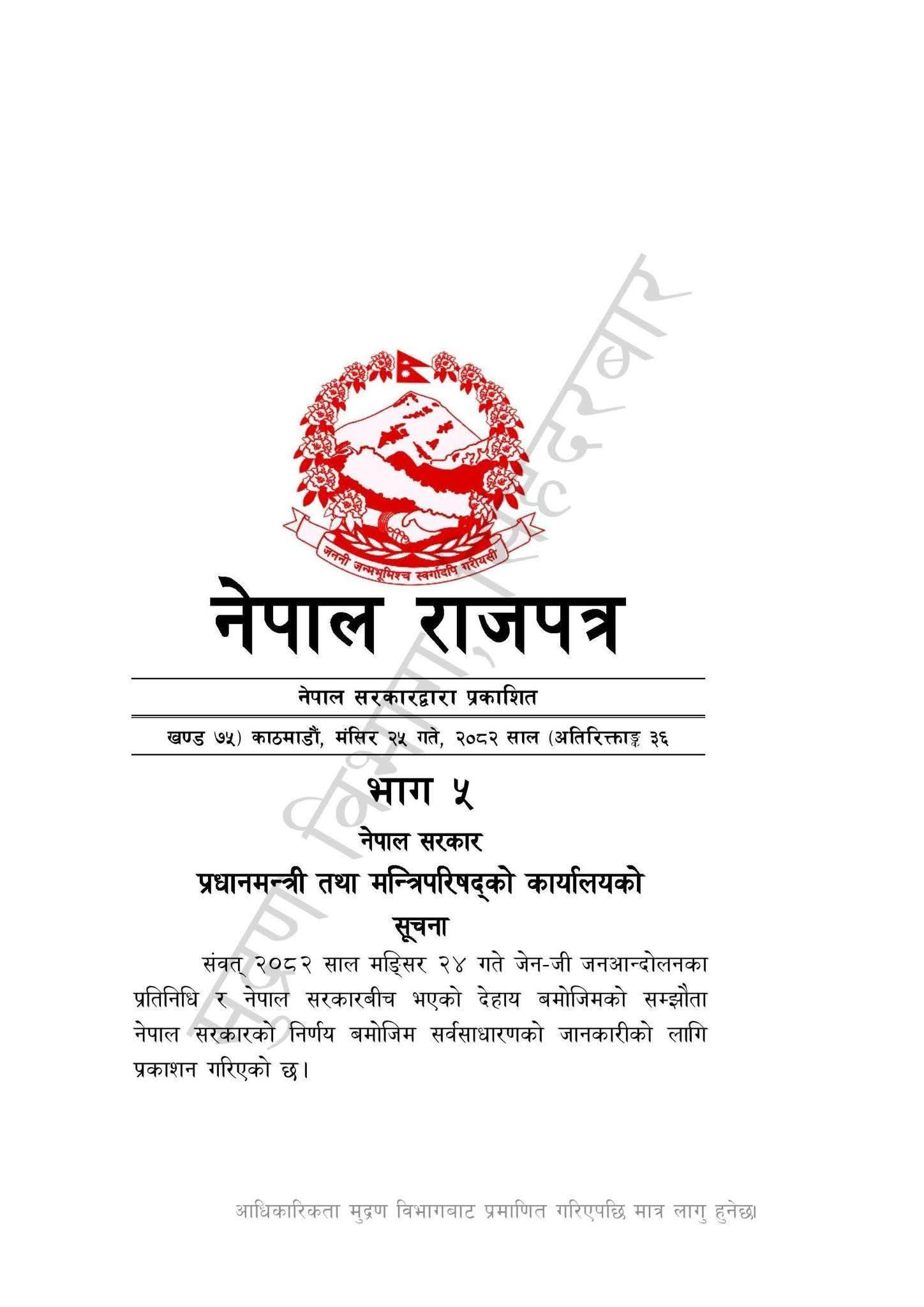
Translation: Statute of National Foundation for Folk Culture, Nepal 2001
The National Foundation for Folk Culture, Nepal preserves and promotes Nepali folk culture through events, publications, and support for artists. It is managed by elected committees and funded by fees and donations, with founders overseeing its work.
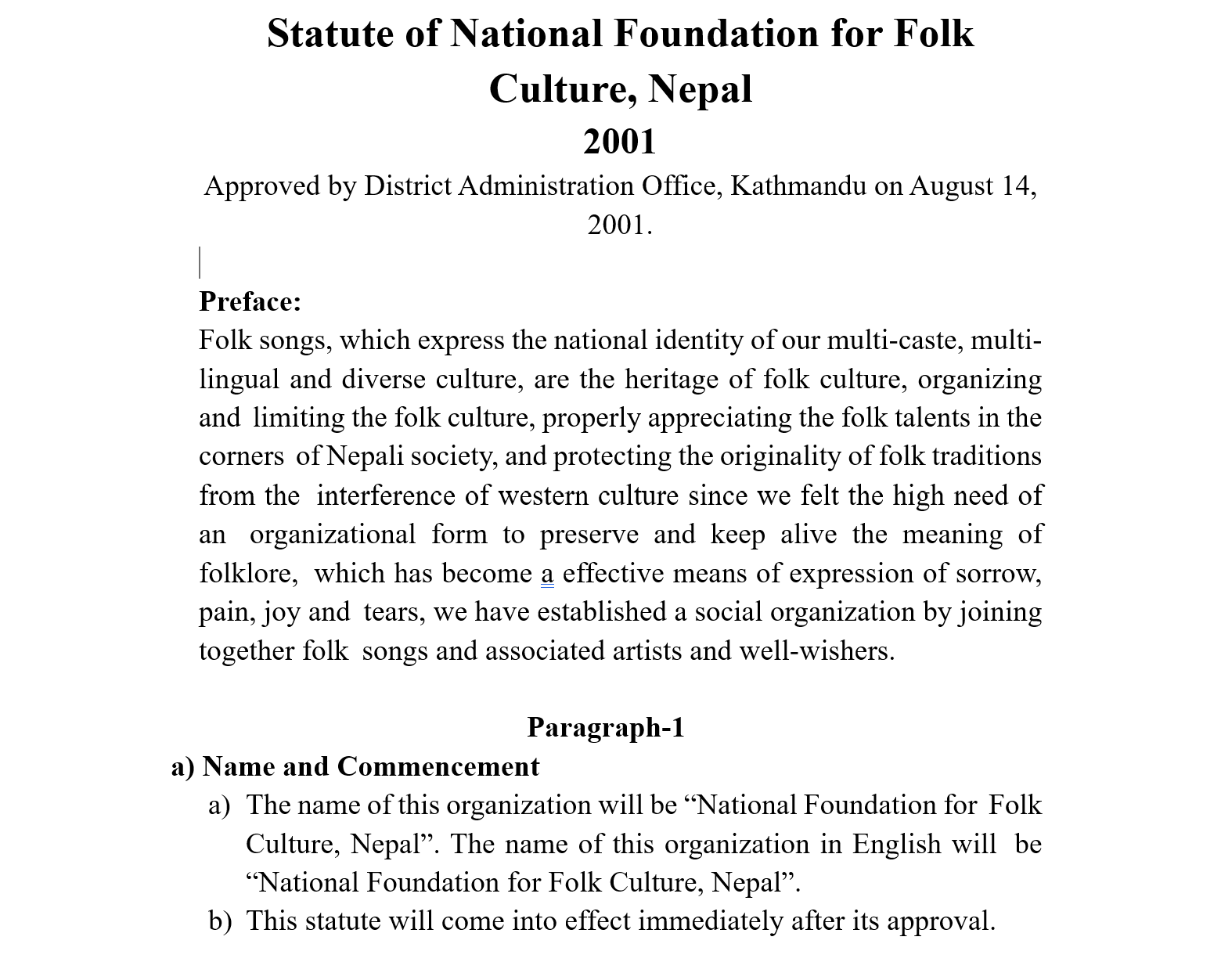
Statute of National Foundation for Folk Culture, Nepal
2001
Approved by District Administration Office, Kathmandu on August 14, 2001.
Preface:
Folk songs, which express the national identity of our multi-caste, multi- lingual and diverse culture, are the heritage of folk culture, organizing and limiting the folk culture, properly appreciating the folk talents in the corners of Nepali society, and protecting the originality of folk traditions from the interference of western culture since we felt the high need of an organizational form to preserve and keep alive the meaning of folklore, which has become a effective means of expression of sorrow, pain, joy and tears, we have established a social organization by joining together folk songs and associated artists and well-wishers.
Paragraph-1
a) Name and Commencement
a) The name of this organization will be “National Foundation for Folk Culture, Nepal”. The name of this organization in English will be “National Foundation for Folk Culture, Nepal”.
b) This statute will come into effect immediately after its approval.
b) Definition:
a) Unless otherwise indicated by the subject matter or the context, the term "Foundation" in this statute refers to the National Folk Song and Folk Culture Foundation of Nepal.
b) Statute means the statute 2001 of National Foundation for Folk Culture, Nepal.
c) The term "member" refers to ordinary, lifetime and executive members who have received membership as per statute of the National Foundation for Folk Culture, Nepal.
d) The rules mean the rules made for the operation of the center, five development zones and district committee units of this foundation.
e) Folk songs and folk culture refers to the competition between men and
women in emotional expressions such as sadness-happiness, love- affection, pain-agony and so on through folk songs.
f) Conference means a national or district conference organized in accordance with this statute.
g) The central committee will have the right to explain clearly if there is any ambiguity or obstacle regarding the statute.
h) The central committee will have the right to amend and amend the statute. It shall be done by majority.
i) Rules can be made.
If necessary for the purpose of the establishment and the implementation of the statute, the central committee under the authority of the law can make by-laws and implement it.
3. Seal of Foundation:
In the seal of this foundation "National Foundation for Folk Culture,
Nepal" will be written and inside the circle there will be Madal, Bansuri,
Sarangi, Murchunga, Tungna in the pentagon, the map of Nepal in the
middle, and the statue of Buddha inside the map.
(NATIONAL FOUNDATION FOR FOLK CULTURE, NEPAL)
4) Flag of the Foundation:
The four corners of the blue background will be marked with the logo of
the foundation.
5) Office:
The Central Office of the Foundation will be in Kathmandu and the offices of the district level committee will be in the relevant districts after getting authority of local authorities.
6. Regarding Membership Fees:
a) Rs. 101/- per annum for ordinary members and a lump sum of Rs. 1001/- will be charged.
b) Provisions related to projects:
i. Any person who does not want to follow the rules mentioned in this statute will be considered ineligible for membership.
ii. A person who works against the institution and tries to disrupt the programs of the institution will be considered ineligible for membership.
c) Non-Continuance of Membership:
d) In case of death.
e) If the mental state is unbalanced.
f) If membership is not renewed.
g) If accepted by resigning.
h) If disqualified by a two-thirds majority of the Foundation.
Paragraph-2.
6. Objectives and Programme:
a) It will be active for the preservation and enhancement of Nepali original folk culture without imitating western culture
b) Encouraging all Nepali caste, creed and language for the protection of their language and culture.
c) To provide more opportunities for people to expose their hidden folk talents.
d) According to the requirements, folk song and folk cultural dance competition will be organized and conducted in any place of the country.
e) To make more use of folk instruments for the preservation of folk music.
f) Special honors will be arranged for any association, organization, company or person who has made an outstanding contribution in the field of folklore.
g) To maintain mutual friendly harmony among folk song singers, and their well- wishers.
h) To teach folk songs folk culture dance.
i) To be develop the sense of nationalism and Nepali originality among all Nepali.
j) A monthly magazine of national folk song and folk culture will be released.
k) Doing various social and community welfare work.
Paragraph - 3
7) Membership Arrangements:
a) Every Nepali folk singer who adheres strictly to this statute with loyalty to the objective and program of this Foundation singers or well-wishers will be considered to be eligible for members.
b) Anyone can become an ordinary and lifetime member by paying the fees specified by this foundation.
c) An advisory committee of maximum 7 members can be formed as decided by the working committee from among the men or women who support this foundation financially, morally and materially. However, the members of the advisory committee will not have the right to run for office and vote in any election of the institution.
Paragraph-4
7. Organizational structure of the Foundation
The organizational structure of the National Foundation for Folk Culture,
Nepal will be as follows.
a) Meetings and conferences. The National Conference will elect the Central Committee through all the representatives from all over the country and discuss the proposals and prepare the statute.
b) Central Committee. Regional committee.
c) Zonal Coordination Committee.
d) District Committee.
e) Who have received membership according to Sub-Article d. (1), (6), and (7) c of Article 6 of Paragraph 3 of this Foundation, the meeting of all statutory members within the district will be considered as a district conference.
f) It will be arranged that the District Conference will form a district committee of up to 15 members including Chairman-1, Vice- Chairman-1, Secretary-1, Treasurer-1, Joint-Secretary-1 and at least 2 female members.
Work, Duties and Rights
1. Chairman:
g) Participating in meetings, conferences, seminars, and so on the behalf of the Foundation.
h) To represent the organization.
i) Make a plan to make the committee dignified.
j) To accept the resignation of committee members and officials.
k) For distribution of work.
2. Vice Chairman:
a) Provide necessary assistance to the Chairman.
b) To act as the chairman in the absence of the chairman.
c) To do assigned other works.
3. Secretary:
a) Issuing notices with the permission of the Chairman.
b) Call the meeting according to the Chairman's advice.
c) Presenting a general report at the conference.
d) To keep records of the organization's work.
e) Correspondence from the office.
f) Doing other assigned work, taking charge of documents.
4. Treasurer:
a) Keep an account of income and expenditure.
b) Presenting the financial report at the national conference.
c) Auditing.
d) Taking charge of financial transactions.
e) To do assigned other works.
f) To operate the central fund.
5. Members:
a) Doing everything that is beneficial to the organization.
b) To do assigned works.
c) Assist in the implementation of the decisions of the meeting.
The work, duties and rights of the members and officers of the Zonal
Coordination Committee shall be as prescribed by the Central Committee.
10. Work, Duties and Rights of District Committee Member, Official:
1. Chairman:
a) To chair the meeting.
b) Contact level by level.
c) To give the deciding vote.
d) Providing general membership.
e) Designate and evaluate the work of officials.
f) Become a representative of the organization at the district level.
g) Follow the instructions of the center.
h) To do the work assigned by the District Conference.
2. Vice-Chairman:
a) To act as the chairman in the absence of the chairman.
b) Assisting the chairman in his work.
c) Do the assigned work.
3. Secretary:
a) Taking responsibility for office management.
b) According to the chairman's advice, correspondence will be sent to the meeting.
c) To present the organizational report in the district conference.
d) Taking responsibility for documents.
e) Do other assigned work.
4. Joint Secretary:
a) Assisting the Secretary.
b) To perform all the duties of the Secretary in the absence of the Secretary.
5. Treasurer:
a) Managing the district fund.
b) To organize the fees of the members.
c) Taking full responsibility for financial transactions.
d) To spend money in consultation with the chairman.
e) Auditing.
f) To approve the financial accounting book in every meeting.
g) Do all the assigned work.
6. Members:
a) Working for the benefit of the organization.
b) Attend the meeting.
c) All the district chairpersons within the zone will be ex-officio members and at least 1 member of the Zone Coordination Committee can be appointed.
d) Officials and members of the central committee, officials and members of the regional coordination committee, district presidents ex officio and based on the number of ordinary members as per the decision of central committee the gathering including the additional number as decided will be called the National Conference.
e) District and National Conferences will be held every 2 years.
f) The National Conference will be able to form a Central Committee with a maximum of 51 members including at least 3 women. The tenure of the Central Committee will be 2 years.
g) The Central Committee will initially consist of the founders, while the National Conference will be made up of representatives from across the country selected through the electoral process.
11. Functions, Work, Duties and Rights of the National Conference:
a) To complete the election of the Central Committee.
b) To pass the financial report.
c) To pass the organizational report
d) Prepare a future action plan.
e) To review the work of the Central Committee.
f) Prepare election committee.
g) Making necessary changes in the legislation of accepting various national and international proposals.
h) Conducting necessary amendment in the Statute
12. Functions, Work, Duties and Rights of the Central Committee:
a) To organize a national level folk-duet song competition.
b) To be a judge in the national level folk song competition.
c) Formation of Regional Coordinating Committee and setting the procedure.
d) Preparing for the National Conference.
e) It is necessary to form a discipline committee from within and
assign tasks, duties and rights.
f) To form various sub-committees as necessary.
g) Prepare annual program.
h) Raising financial resources.
i) Conducting conferences, seminars and so on.
j) Giving necessary suggestions to the lower committee.
k) To do other work to fulfill the purpose of the organization.
l) Clarification of unclear matters in the statute.
m) Opening and operating an office.
n) Appointing necessary staff and setting salaries.
o) Appointing representatives in folklore programs organized by other associations.
p) Providing necessary support and advice to folk song organizers.
q) q) To prepare other programs of folk culture.
13. Functions, Work, Duties and Rights of the District Conference:
a) Review organizational and financial reports.
b) Prepare annual program.
c) To review the work done by the district committee.
d) Conduct district committee elections.
14. Functions, Work, Duties and Rights of District Committee:
a) Organizing folk song competitions.
b) Distribution of ordinary membership.
c) Recommend to the Central Committee for life membership.
d) Taking participating groups to competitions.
e) Arranging the district fund.
f) Making arrangements related to office operation.
g) To maintain relations with other associations.
h) To cooperate with local bodies in the protection of cultural
heritage.
i) Follow the instructions given by the Central Committee.
j) Arranging awards and honors for songs and singers.
k) To inform members well.
l) 75% of the regular collection of member fees will be kept in the
district fund and 25% will be sent to the central fund.
15. Work, duties and rights of the officers of the working committee:
1. Chairman:
The Chairman of the Central Committee shall have the following
functions, work, duties and rights.
a) To preside over the meeting.
b) Give the deciding vote.
c) Taking responsibility and fulfilling it.
d) Taking necessary opinions, giving advice and participating in
discussions.
2. Elected officials of any level are not allowed to nominate.
3. If it is in the interest of this institution, the District Working Committee
can be directly nominated for the post of central member or can be nominated level by level.
4. The right to nominate will be protected by the founding officers.
Paragraph-6
16. Financial arrangements:
The income source of the establishment will be as follows:
a) Subscription distribution and renewal fees.
b) Annual fees to be deposited in the fund.
c) Support, assistance and grants received from national and
international charitable organizations and individuals.
d) Other income.
e) Income received from various programs organized by the
Foundation from time to time.
17. Fund:
This foundation will have a fund. The account in which the income received
from various sources is received will be operated by the joint signature of
the President and Treasurer of the Foundation.
18. Audit:
a) The annual income and expenditure of this institution will be audited after the end of the financial year by an accredited auditor of His Majesty's Government.
b) The said audit report will be released to the relevant bodies every year.
19. Transitional state:
a) Within 6 months of the registration of the statute, a new working committee will be formed in accordance with this statute.
b) The ad-hoc committee registered by statute will continue until the first conference.
c) If this statute is registered, all actions performed will be deemed to be in accordance with this statute.
Paragraph -7
28. Provisions related to election:
The election of this foundation will be conducted according to the
following rules:
a) The election committee of the national conference will complete the election of the central committee.
b) The election committee elected by the district conference will conduct the election of the district committee
c) The delegates of the conference shall have the right to nominate
and vote for the relevant committees.
The election committee will prepare all the procedures related to the election. The newly elected chairperson will hear from the veteran members present at the conference and other members will hear from the chairperson. The oath will be as mentioned in Schedule-1
21. Quorum:
a) This institution will consider the presence of 75 percent of the quorum Signatures Sd. His Majesty’s be held without reaching the required number for the first time, 51 percent will be considered as a quorum for other meetings.
b) The required quorum for the District Conference of this institution is 51 percent will be considered. If the conference is adjourned without reaching the required number in the first conference, 40 percent will be considered as a quorum for the second conference.
22. Schedule of the Foundation's Working Committee:
a) The Central Committee of 51-members must bring one woman out of three from each development area.
b) In the development area, each zone should include 1 woman and 3 people.
c) Only 2 people, one woman and one man from each district in the zone.
d) The district committee will be formed by holding a district conference with the representative of development area and zone representative in the district.
23. Motion of No Confidence:
1) One-third of the members' signatures will be required to file a no-confidence motion against any officer of the institution. If the relevant committee passes by a two-thirds majority, the accused member will be removed from the committee and another person will be nominated. But the accused person will not be deprived of the clean-up day.
24. Amendments to statute and Regulations:
a) If any clause needs to be added or removed or modified in this constitution, it can be done by the central conference and two thirds of the agreement is required.
b) The central committee may implement the regulations to achieve the objectives of the establishment without conflicting with this statute under the prevailing law.
Penalty, Punishment, Appreciation and Reward
a) According to the decision of the establishment, if there is any damage to this reputation actions will be taken in the concerned body for recovery of damages or according to the nature of the mistake.
b) The central committee can give appreciation, awards and certificates to anyone who has made a significant contribution to the welfare of the institution.
Paragraph 8
26. Protection
1) The patronage of this organization will be given to the founding members.
2) If necessary, the founding members will intervene in the work of the central committee and expel those who are considered against the organization.
3) The founding members of the organization will automatically become life members.
4) There will be no political interference in the work of this organization and it will remain within the dignity of the constitution of His Majesty’s of government.
26. Procedure of Constituent Committee and Elected Committees
1) The chairman of the district committee will submit the report of district working committee to the zone committee and provide instructions to the secretary.
a) The District Committee can submit the report to the Zonal Committee.
b) If the district committee has to form other initial committees in their district, they can form them only by informing the Zonal Committee.
c) The chairman of the district committee can be an ex-officio member of the zonal committee directly.
2) The Chairman of the Zonal Committee shall submit his report to the Development Zone Committee and by instructing the Secretary of the Zonal Committee.
a) Zonal committee can submit its all reports of the zone to the development area.
b) The regional committee will work according to the direction of the development region committee.
c) The chairman of the zone committee can be an ex-officio member of the development zone committee directly.
d) In case of zonal committee, visit their district annually.
3. The Chairman of the Development Region can submit the report of
his/her development region to the central committee
a) Submit the report of the entire development region to the central committee after passing it on from the committee of the development region.
b) To make monthly visits to one's development region in case of committee of own development region.
c) If the development area needs to decide something or bring a new reporting agent, only with the opinion of both the central committee and the founder, they can bring an agent for the whole of their development region until the certain time. The agent will retire after two years.
d) The report from the lower body will be sent to the higher body.
4. The Chairman of the central committee or the elected chairman will
instruct the secretary of the central committee to convene a monthly
meeting.
a) The elected chairman should discuss about the agents from all the bodies and pass this agent through the general meeting or the board of directors and submit it to the founding committee.
b) The central committee can only give directions to the development region committee.
c) Inability to give instructions to agencies other than development region committee.
5. The officers of the founding committee can inspect from the central
committee to the district committee.
a) The Chairman of the Founding Committee may direct the Secretary of the Founding Committee to convene the meeting of the Founding Committee.
b) Every two years, in of the founding committee, each district can nominate in the area of regional development.
c) If it is in the interest of this institution, it is recommended to nominate directly from the district to the central committee.
d) Any committee at any level can intervene if there is an action to the
detriment of this institution.
If any member or official acts against the organization, the power of the founding officer can be removed directly.
6) Zonal Committee to give information about the program to the District Committee.
a) The Zone Committee shall work as per the direction of the Development Region Committee.
b) The Development Region Committee will work according to the instructions of the Central Committee.
c) The central committee will inform the founding committee and move the program forward.
d) Cannot be nominated by any select committee.
e) Since the elected committee will be in controversy, there is a high possibility of the nomination mace dispute, so the nomination the founding officers will do it.
7) The zonal committee may accept the resignation of the member of the
district committee to the development region committee by a majority
vote of the chairperson of the zonal committee, but the zonal committee
can only approve the resignation by sending a letter of information to the
developmen region committee. This procedure will be applicable at all
levels.
a) To discuss the agents from the elected central committee of the chairman of the duty of founding committee chairperson.
b) Inspecting the work according to the agent from all levels of the committee.
c) The Chairman of the Founding Committee can direct or supervise up to the District Working Committee by asking for advice from his/her committee.
d) The founding members can be nominated by the central committee or lifetime members.
Paragraph -9
27. Miscellaneous
1. Candidates for the posts under this statute will be in accordance with the
prevailing Nepalese law.
1.1) Interpretation and amendment of statutes: -
a) This Statute can only be interpreted by the executive committee.
b) If two-thirds of all members pass a written resolution, this
statute can be amended. Such amendment shall be affected only after obtaining approval from the local authority.
d) No matter what is written in this statute, it will automatically be repealed to the extent that it contradicts the prevailing Nepalese laws.
1.2) Status of Foundation: -
The Statute of the foundation will be as follows.
a) It can acquire, sell, use and transfer ownership of movable and immovable property in his name.
b) Foundation can file a claim against someone and defend against a claim against it.
c) A separate seal can be used for the work director and if the documents on which such seal is used are proven otherwise, it will be considered to be from a different association.
1.3) Rule making
To organize the work in accordance with the purpose of the law, it will
formulate the regulations. Until such a rule is made, it will be as decided by the executive committee.
1.4) Dissolution of Foundation:
a) In case of dissolution of the foundation due to any reason, 90% majority of all the members of the foundation may dissolve the association.
b) If it is dissolved in this way, the remaining assets will be transferred to the His Majesty's Government after fulfilling its obligations.
Schedule-1
Oath to be taken by elected members and officers:
I will work with utmost sincerity in the position of this institution. I will try
my best to manage the field of folk culture, which is considered as a heritage
of Nepali original culture. I will consider the work of the foundation as my
work. I will always respect the folk music and take a strong stand against the
western culture that has invaded Nepali land.
Statute Amendment of National Foundation for Folk Culture, Nepal
S No.
Previous Arrangements
Current Arrangement
Reason
1
One can get ordinary and
lifetime membership after
paying fee fixed by (b) of
7 of Paragraph 3 of
previous Statute
By paying the fees specified by this
establishment, one can become an ordinary
member, a lifetime member. In addition, the
decision of the central working committee
will provide free honorary members for
making special contributions in the field of
art and cultural preservation.
Because
and
should
respected
2
In (a) of 8 of Paragraph 3
of previous _ Statute
ordinary membership fee
is Rs. 101/- and lifetime
membership fee is Rs.
1001/-
In (a) of 8 of Paragraph 3 of previous Statute
ordinary membership fee is Rs. 1000/- and
lifetime membership fee is Rs. 5000/-
Because the fee
should be
increased as per
the time.
Recent Articles
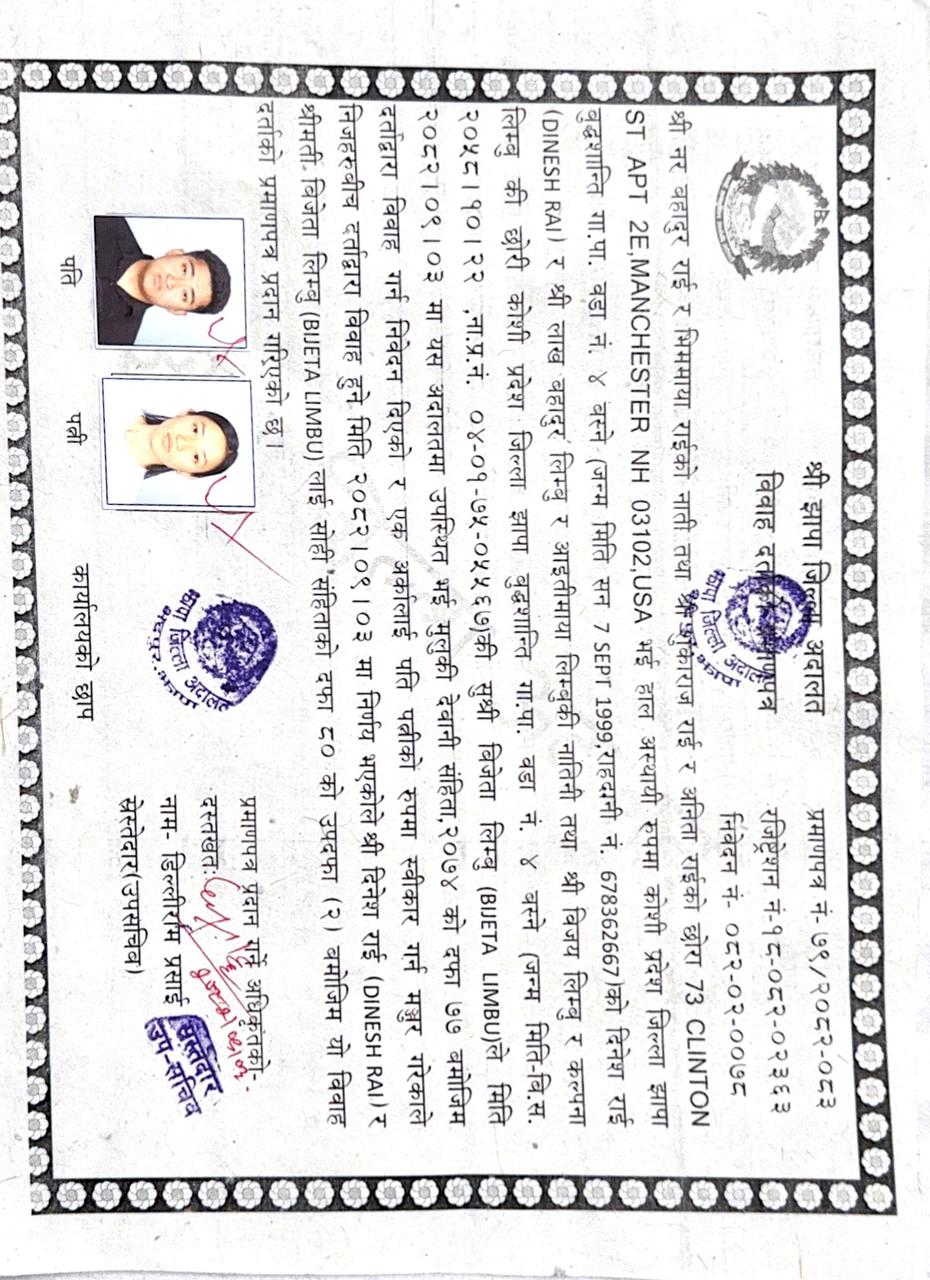
Court Marriage Certificate
Dec 25, 2025
Notary: Letter to Immigration
Dec 25, 2025
Translation: Human Trafficking
Dec 12, 2025
Translation: Contract
Dec 11, 2025