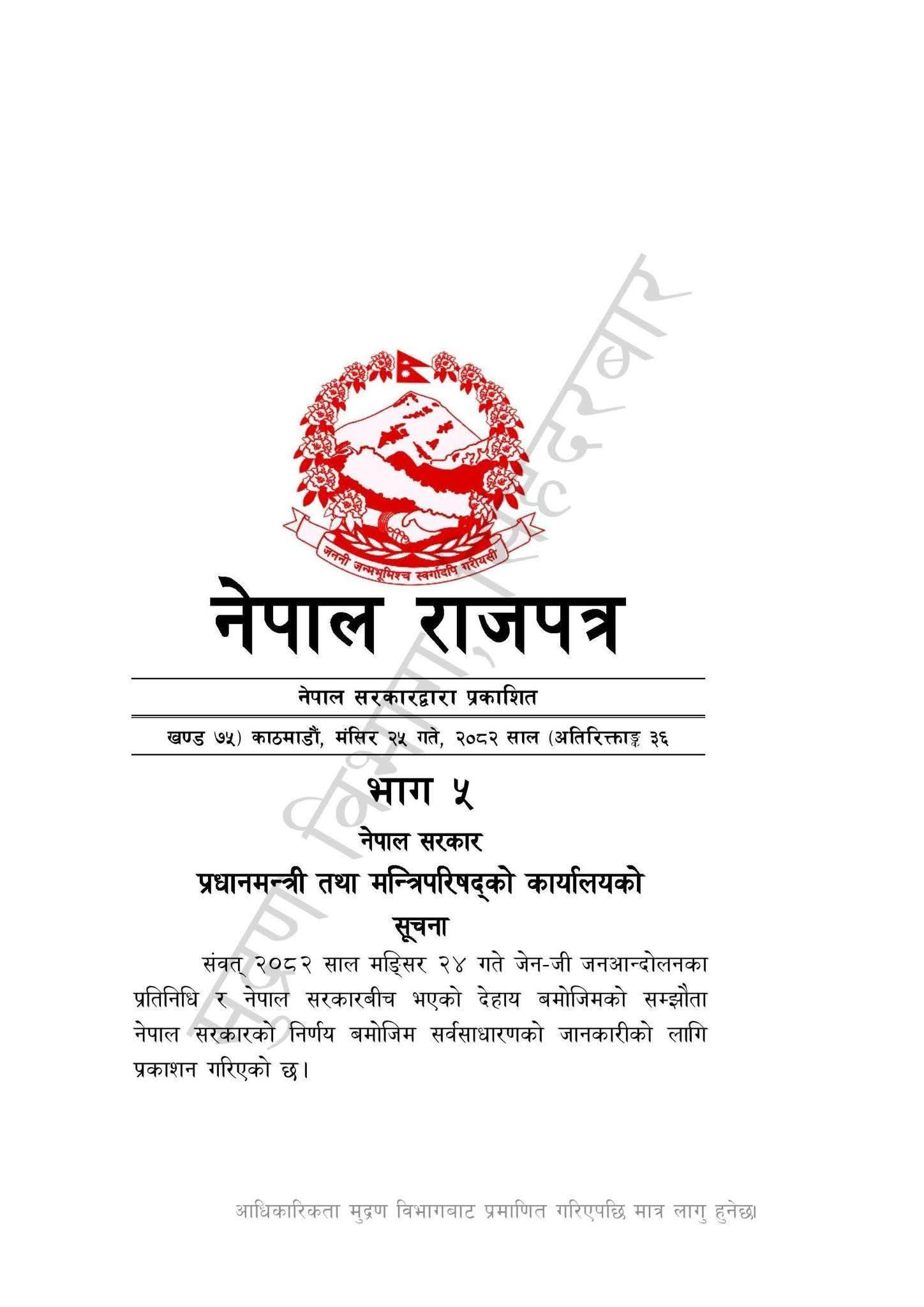
Translation: Statute of Sahayatra
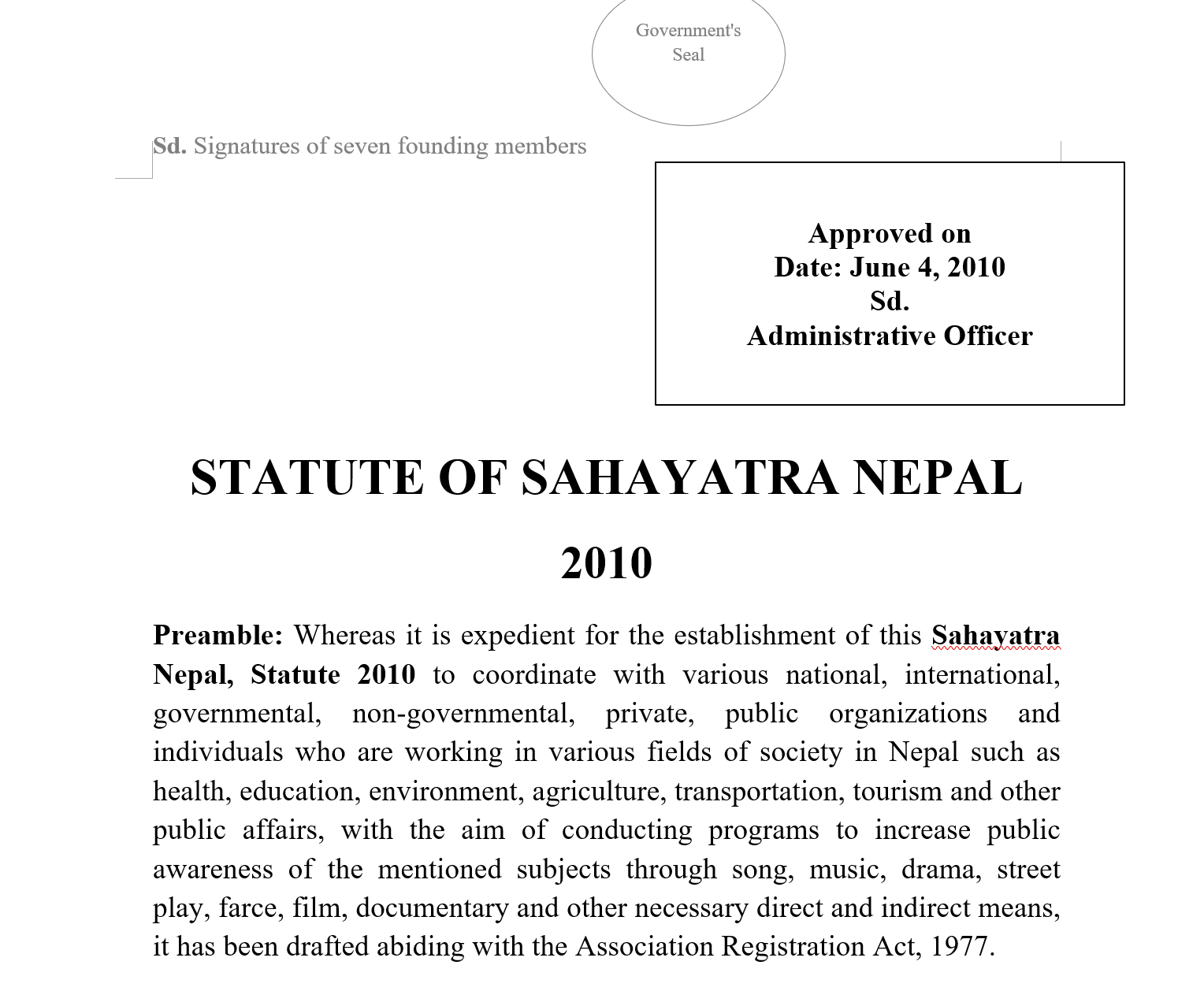
Sahayatra Nepal is a non-profit organization that promotes public awareness on social, cultural, and environmental issues through music, arts, and media. It has a structured governance system, defined membership, transparent fund management, and collaborates with national and international bodies to achieve its objectives.
Statute of Sahayatra Nepal
2010
Preamble: Whereas it is expedient for the establishment of this Sahayatra Nepal, Statute 2010 to coordinate with various national, international, governmental, non-governmental, private, public organizations and individuals who are working in various fields of society in Nepal such as health, education, environment, agriculture, transportation, tourism and other public affairs, with the aim of conducting programs to increase public awareness of the mentioned subjects through song, music, drama, street play, farce, film, documentary and other necessary direct and indirect means, it has been drafted abiding with the Association Registration Act, 1977.
Chapter - 1
Preliminary
1. Name of organization: (1) The name of this organization shall be Sahayatra Nepal. It shall be Sahayatra in short. It shall be known as SAHAYATRA NEPAL in English. It shall be SAYAN in abbreviation.
(a) Address of the Organization: -
The office of this association shall be situated at Anamnagar, Kathmandu Metropolitan City Ward No. 32. The office shall be changed by informing concerned entity as per requirement.
(b) Scope of the Organization:
(c) Commencement: - This statue shall be deemed to have been commenced from the registration of this statute.
(d) Existence of the organization: - This organization shall be inseparable inheritor, organized, self-governing, non-profit, non-political and non-government social organization. The organization shall neither be engaged in any income generating activities beyond its objectives, nor shall it provide any consultancy service for a fee or without fee.
2. Definitions: Unless the subject or the context otherwise requires, in this statue:
a. "statute" means statute of Sahayatra Nepal 2010.
b. "organization" means Sahayatra Nepal.
c. "committee" means the executive committee of Section 13 of this statute.
d. "meeting" means general meeting and special general meeting conducted according to this act.
e. "official" means officials of this organization.
f. "rule and by-rule" means rule and by-rule framed under this act.
g. "local officer" means chief district officer.
h. "prescribed" or " as prescribed " means prescribed or prescribed as in this statue and rule framed under this statute.
i. "local body" means VDC, Municipality, Sub-Metropolitan City, Metropolitan City and DDC.
j. "article" means article of this statute.
k. "sub article" means sub article of this statute.
l. "regulation" means collection of regulations framed under performance statute and passed by the concerned authorized body.
m. 'general meeting' means the meeting conducted by the voting member of the statute.
n. "central committee" means the Central Executive Committee. Succession shall be carried out to achieve mentioned objective of this executive committee.
o. "officials" means an executive committee of seven members along with chairman formed under this statute for daily performance of the organization.
p. The interpretation and decision of the executive committee shall be final otherwise no ambiguity or double meaning mention in the article, sub article of statute of this organization.
q. Quorum of all the part of this organization shall be 51% unless specified by this statute.
3. Seal and Symbol of the Organization:
There shall be a separate seal and stamp of the organization not contrary to the prevailing law. The format of seal and stamp shall be under schedule-1. But if it matches with the previously registered organization then it shall be amended by the process of amendment.
Chapter - 2
Objectives
4. Objectives:
(a) To perform social service as a nonprofit public welfare organization
(b) To study and research various fundamental song music art culture, custom and costumes.
(c) To operate necessary programs for public awareness related to health, education, environment, agriculture, transportation, tourism and other various public interest.
(d) To collaborate with various national, international, governmental, non-governmental, private, and public bodies, organizations, and individuals working on such topics to organize, conduct, and participate in various programs. These programs aim to raise public awareness through direct and indirect means such as songs, music, plays, street plays, skits, films, documentaries, and other necessary mediums by presenting and broadcasting them publicly.
(e) To organize various programs for the conservation and protection of original song, music, art culture, custom and costumes.
(f) To maintain relation through national and international assembly, convention, websites.
(g) To perform necessary activities related to broadcast, publication for achieving the objective of the organization.
5. Activities to Achieved Objective of the Organization:
To achieve mentioned objective of the organization following activities shall be done:
(a) The organization shall implement the above objectives only after obtaining permission or authorization from the relevant bodies in accordance with the prevailing laws of Nepal.
(b) The organization shall construct or lease the necessary buildings and can purchase or lease office equipment such as computers, telephones, and fax machines, as well as vehicles.
(c) The organization shall appoint the necessary employees and determine their terms of service.
(d) The organization shall import, purchase, or lease machinery, tools, and equipment, as well as other necessary items to achieve its objectives, with concessions from the Government of Nepal.
(e) The organization shall acquire membership in local, national, and international associations that have similar objectives or agree with the organization's objectives, and coordinate with these associations.
(f) The organization shall conduct research and studies, training, visits, interactions, and seminars as necessary to achieve its objectives.
(g) The organization shall produce, publish, and broadcast bulletins, audiovisual materials, and documentaries related to its plans and programs.
(h) The organization shall promote mutual cooperation, understanding, goodwill, and tolerance among all ethnic groups, genders, and classes of the country's citizens by conducting effective public awareness campaigns through songs, music, art, and culture.
Chapter - 3
Membership
6. Classification of Membership:
The classification of member of this organization shall be 5 types as per following:
(a) General Member:
Any Nepali citizen who meets the qualifications outlined in section 7 of this statute and applies following the specified procedure will be considered an general member of the organization.
(b) Founding Member:
The official at the time of the organization's registration will be considered founding members. Additionally, individuals who contributed to the formation of the organization but were not part of the ad hoc committee can be accepted as founding members by the first meeting of the management committee. Founding members must take general or lifetime membership and pay the prescribed fees as per the statute.
(c) Lifetime Member:
Individuals who make special contributions to the development of the organization will be granted lifetime membership following the prescribed procedure.
(d) Organizational Member:
The organization registered under the government of Nepal shall be organizational member following prescribed procedure.
(e) Honorary Member: -
The organization may grant honorary membership to specialized artists, social workers, and esteemed Nepali and foreign citizens it deems appropriate. However, honorary members will not have voting rights.
7. Qualifications Required for Membership:
One must meet the following qualifications to be a member of this organization:
(a) Must be a Nepali citizen, except for honorary members.
(b) Must be at least 16 years old at the time of applying for membership.
(c) Must not be mentally unsound.
(d) Must not have misappropriated public property.
(e) Must not have been convicted of a crime or corruption involving moral turpitude.
(f) In the case of organizational members, the organization must be legally recognized.
8. Circumstances in Which One Cannot Obtain or Retain Membership:
A person will be deemed ineligible for membership in the following situations:
(a) Non-Nepali citizen.
(b) Not attained 16 years of age.
(c) Mentally unsound or insane.
(d) Proven to have misappropriated public property.
(e) Convicted of a crime or corruption involving moral turpitude.
(f) Having a personal interest in the business of the related organization.
(g) Declared bankrupt.
(h) Convicted of any kind of theft, fraud, forgery, or embezzlement or misuse of entrusted property, or corruption by a court within one year.
(i) In the case of organizational members, if the related entity is not legally registered, the registration is canceled, or the cancellation process has begun.
9. Termination of Membership:
No person shall remain a member of the organization in the following circumstances:
(a) If they become ineligible as per section 8 of this statute.
(b) If a resolution is passed by a 75% majority of the general meeting members to remove them from membership.
(c) If resignation of member from the position is accepted.
(d) If it is proven by a court that the organization has committed maliciously or dishonesty in its operations.
(e) If they engage in any activity prohibited by this statute.
(f) If the organization is dissolved.
(g) If they fail to pay the membership fee.
(h) If they participate in or assist in any matter contrary to the objectives of the organization and interests, their membership will be terminated.
10. Membership Fee and Process of Providing Membership:
Membership can be obtained by paying prescribed fee in the Sub Section in the details according to Section 6 of this statute.
1. General Member
(a) A person who wishes to obtain general membership must pay an entry fee of Rs. 551/- and an annual fee of Rs. 251/-. The application submitted as per the prescribed process can be granted general membership by the decision of the Executive Committee.
(b) Such general members must pay an annual renewal fee of Rs. 251/-.
(c) Members obtaining general membership must renew it by the end of the month of mid-July each year, and thereafter, they can renew by paying the additional fee as specified.
2. Founder Member:
a) The officials of the ad hoc committee at the time of the organization's registration will be founder members.
b) Founder members can become general or lifetime members by paying the fees as mentioned in the statute. Only then will they be eligible to vote in the general meeting.
3. Lifetime Member: Persons who pay a lump sum of Rs. 5001/- (in words: five thousand one) and apply as per the specified process can be granted lifetime membership by the decision of the Executive Committee.
4. Organizational Member: Organization that pay a lump sum of Rs. 25,001/- and apply as per the specified process can be granted organizational membership by the decision of the Executive Committee. organizational members shall have the same rights as lifetime members.
5. Honorary Member: The General Meeting may grant honorary membership to artists, social workers, distinguished individuals, and respected Nepali citizens deemed appropriate. However, honorary members will not have voting rights.
6. If a decision is made not to grant membership to an applicant, the reason for this decision shall be informed to the applicant.
7. All members must adhere to the provisions of this Statute and the rules and regulations made under it.
8. The organization shall maintain separate record books for the members as specified in sub-articles 1, 2, 3, 4, and 5.
Chapter - 4
Provisions related to the General Assembly, Executive Committee, and Meeting
11. Formation of the General Assembly:
1. The General Assembly of this organization will be formed from members, except honorary members, who obtain membership as per section 7 of the Statute. Honorary members will be invited. The General Assembly will be the supreme body of the organization.
2. The General Assembly of this organization shall be as follows:
a) The Annual General Assembly shall be held once a year.
b) Special General Assembly: If 1/4 (one-fourth) of the total members of the organization request a Special General Assembly stating the reason, the Executive Committee must convene a Special General Assembly within at least 7 (seven) days. However, another Special General Assembly cannot be convened within six months of the previous General Assembly or Special Assembly.
3. The first Annual General Assembly of this organization will be held within two months from the date of the end of the fiscal year in which the organization was established, and subsequent Annual General Assemblies will be held within 2 (two) months from the end of the fiscal year.
4. To hold the Annual General Assembly of this organization, all ordinary members will be notified of the place, date, and agenda of the assembly at least 15 days in advance, and for the Special General Assembly, at least 7 (seven) days in advance.
5. If the quorum as per Article 18 of the Statute is not met in the General Assembly or Special General Assembly convened according to sub-article (4), a General Assembly will be reconvened with at least 7 (seven) days' notice.
6. Separate decision books will be maintained for the General Assembly and Special General Assembly.
12. Functions, Power and Duties of the General Assembly:
The duties, responsibilities, and rights of the General Assembly are as follows:
a) Approve the plans, programs, and annual budget presented by the Executive Committee.
b) Discuss and approve the annual audit report received from the auditor, discuss irregularities identified in the audit report, regularize the accounts, and direct the Executive Committee to recover any unaccounted amounts.
c) Appoint an auditor for the next year.
d) Evaluate the annual progress report and activities of the organization and provide necessary directions to the Executive Committee.
e) Conduct elections for the Executive Committee members according to the process specified in the Statute when the tenure of the Executive Committee members ends.
f) Approve amendments to the Statute, rules, and regulations proposed by the Executive Committee.
g) Grant honorary memberships.
h) Approve actions taken by the Executive Committee in the interest of the organization.
i) Approve the staffing levels, salaries, allowances, and other benefits of employees as proposed by the Executive Committee, funded from the organization's internal resources.
j) Play a leading role in the organization.
k) The General Assembly may ask for an explanation from any member of the organization regarding their misconduct or other wrongful activities. If a satisfactory response is not received and suspicious behavior is observed, the member can be suspended or their membership can be canceled.
13. Formation of the Executive Committee:
1) A 7-member Executive Committee will be formed from the members elected by the General Assembly, with the following officials:
1. Chairman - 1
2. Vice-Chairman - 1
3. General Secretary - 1
4. Secretary - 1
5. Treasurer – 1
6. Members-2
Total-7
However, if the position of the chairman is vacant, the vice-chairman and other officers and members shall be nominated by the executive committee from the members of the general assembly until the next General assembly.
2) The term of the Committee shall be two years.
3) If any position of a member in the Committee becomes vacant before the annual General Assembly, the Committee shall elect the remaining term members by consensus, as conducted by the Committee. Similarly, for other positions, elections shall be conducted as per the rules for the remaining term.
4) The Chairman shall call for Committee assembly as necessary. However, if 51% of the total number of Committee officers demand a assembly, the Chairman must call for the Committee assembly promptly.
5) If 51% of the total Committee officers are not present, the Committee assembly shall not proceed.
6) The Chairman shall chair the Committee assembly. In case of the Chairman's absence, the Vice Chairman and Secretary shall also be absent. In such cases, the senior members present shall chair the assembly.
7) Decisions in the Committee assembly shall be valid with a majority vote. In case of a tie, the Chairman shall have the deciding vote.
8) Details of discussions and decisions made in the Committee meetings shall be documented. Moreover, any objections raised by members present at the meeting shall be addressed accordingly.
9) All organizational activities shall be carried out based on decisions made by the Committee.
10) Matters written in the above paragraphs, if approved in writing by all Committee officers, can be executed without a meeting, by including such approvals in the decision book. Such agreements as per the above shall be considered valid decisions in the Committee meetings.
14. The functions, duties, and power of the Committee shall be as follows:
1. To prepare the annual work plan and estimated budget of the organization for the upcoming year to present to the General Meeting.
2. To implement decisions of the General Meeting by adhering to the provisions.
3. To execute programs beneficial to the organization.
4. To be accountable to the General Meeting.
5. To utilize available resources and sources to the maximum extent possible for achieving the organization's objectives.
6. To develop work plans, gather resources, implement, supervise, and evaluate organizational activities.
7. To safeguard the organization's funds and properties and operate bank accounts securely.
8. To enforce rules and regulations related to the service terms and facilities of organization staff, approved by the General Meeting.
9. To form advisory committees, other committees, and sub-committees with suitable individuals during the term of office, and distribute work according to requirements in order to fulfill the objectives of the organization.
10. To carry out a leading role in the organization.
11. To collaborate with various domestic and foreign organizations to achieve the objectives, provide and receive assistance, and maintain contact.
12. To publish souvenirs, and magazines in the name of the organization.
13. To organize meetings, conferences, discussions, and workshops; to conduct and facilitate research and studies; to invite other organizations or individuals, and to send representatives to invitations from others.
14. To represent this organization officially.
15. To grant membership to those who wish to join this organization.
16. To present necessary investigation action to the general assembly, along with recommendations of members who have been subjected to action.
15. Resignation: The president may resign by submitting a resignation to the executive committee through the vice president, and the vice president and other officials may resign by submitting a resignation to the president. The resignation must be approved by the executive committee.
16. Other Committees:
1. The executive committee may form other committees or sub-committees within the scope of this statute, as needed for the operation of the organization, but the work of such committees or sub-committees will be as determined by the executive committee. However, the formation of other committees or sub-committees must be approved by the general assembly.
2. The work of the sub-committees shall be as determined by the executive committee.
Chapter - 5
Function, Duties and Power of the Official:
17. Function, Duties and Power of the Official: The function, duties and power of the official of the executive committee will be as follows:
1. Duties, Responsibilities, and Authority of the President:
a. To preside over meetings of the committee and assembly, and to conduct meetings.
b. To cast the deciding vote.
c. To represent the organization or to appoint a representative.
d. To lead the organization.
e. To direct the secretary to call meetings as needed.
f. To distribute work among other officials and members.
g. To certify records.
h. To cast the deciding vote in the event of a dispute during an executive committee meeting.
i. To protect, oversee, and control all the property of the organization, and to provide necessary direction to ensure progress and continuity towards achieving objectives.
j. To call a meeting if a written request for an emergency general assembly is received from one-third of the members.
k. To ensure that any program of the organization is conducted and implemented according to the rules and decisions of the relevant authority.
l. To handle the duties of the absent official for the remaining term if any official of the executive committee is absent, the president has the authority to direct another member.
m. The members of the executive committee shall be fully accountable to the president while implementing the programs and activities of the organization.
2. Duties, Responsibilities, and Authority of the Vice President:
a. To assist the president.
b. To perform the duties of the president in the absence of the president.
c. To carry out other responsibilities assigned by the president.
3. Duties, Responsibilities, and Authority of the General Secretary:
a. To oversee and manage the secretariat of the organization.
b. To keep records safe.
c. To call the general assembly and executive committee meetings under the direction of the president.
d. To oversee, control, correspond, and direct the daily administrative activities of the organization under the direction of the president.
e. To prepare and securely maintain minutes of the decisions and programs approved by the general assembly and executive committee.
f. To assign responsibility for the implementation of approved programs to the members of the organization, ensuring that progress reports are made available to the executive committee.
g. To ensure the implementation of decisions approved by the general assembly and the executive committee.
h. To present the annual report of the organization on behalf of the executive committee with the consent of the president to the general assembly.
i. To conduct the programs included in the annual plan.
j. To manage and oversee the daily administration of the organization and to run the work through employees.
k. To fulfill other responsibilities assigned by the president.
4. Duties, Responsibilities, and Authority of the Secretary:
a. To assist the general secretary.
b. To perform the duties of the general secretary in their absence.
c. To carry out other responsibilities assigned by the general secretary.
5. Duties, Responsibilities, and Authority of the Treasurer:
a. To supervise and manage the funds of the organization.
b. To present the annual program and budget to the general assembly.
c. To maintain proper accounts.
d. To conduct regular annual audits.
e. To send reminders and correspondence related to the collection of membership fees and other income sources.
f. To keep accurate records of income and expenses according to the decisions of the relevant authorities. The treasurer shall present the annual financial report and audit report to the general assembly on behalf of the executive committee for the upcoming year.
g. To take special responsibility for the financial management of the organization and to ensure expenditure in accordance with the annual budget.
h. To work under the direction of the president.
6. Function, Duties and power of Members:
a. To actively participate in committee meetings.
b. Every member of this organization must be dedicated in mind, speech, and action for the progress and welfare of the organization, and must play a constructive role in its activities.
c. To strictly adhere to the statute and rules of the organization.
d. Members must uphold their professional qualifications and enhance mutual cooperation and goodwill.
e. It shall be the duty of every member to provide as much active support as possible in every activity carried out by the organization.
f. It shall be duty of all members to contribute in regards to the policies, programs, information, and calls of the organization actively.
g. Only active and lifetime members have the right to vote for positions on the executive committee.
h. All members have the right to be informed about the necessary details of the organization's entire operations. Access to highly confidential or special documents will require the president's permission.
i. Members may request consultation and legal protection from the organization on matters related to their professional interests.
18. Quorum:
1. The general meeting shall not proceed without the presence of 60% of the total number of general members.
2. However, the meeting will not be obstructed if 51% of the total number of members are present at the reconvened general meeting as mentioned in sub-section (5) of section 11 of the statute.
Chapter - 6
Financial Management
19. Funds of the Organization:
1. The organization will have its separate fund, and the following amounts will be deposited in this fund:
a. The amount received from membership entrance fees and membership fees.
b. The amount received from donations and aid given voluntarily by someone, and the money earned by artists through their artistry on various occasions.
c. The amount received from the sale of the movable and immovable property or other assets of the organization.
d. The amount received as aid from foreign organizations, individuals, or international associations.
e. The amount received as aid or cooperation from local bodies.
f. Donations, gifts, assistance, etc. received from various individuals, organizations, governmental and non-governmental bodies.
g. The amount received from special additional activities.
h. The amount earned or received from any plan, research, and service-oriented program operated through the organization.
i. Funds from Other Sources
j. Lumpsum amount obtained from Lifetime Members
2. If the organization receives financial assistance from foreign associations, organizations, or individuals, it shall obtain approval from the Ministry of Finance, Government of Nepal.
3. Funds received by the organization shall be deposited in a local bank account and managed from there.
4. Proceeds from various activities of the organization shall be used as per the objectives of the organization without misappropriation.
20. Account Management: The organization's bank account shall be jointly operated by one of the President or Secretary and the Treasurer with a mandatory joint signature as per prevailing laws and regulations for expenditure and maintaining the account.
21. Methods for Spending Account Funds: Expenditure shall be made from the organization's account following the deposited amount and by adopting the following methods:
1. Annual budget plan and program shall not be spent from the fund without approval from the General Meeting.
2. Funds shall be spent from the fund subject to the budget and program passed by the general assembly
3. The financial report of the amount spent from the fund must be submitted to the general assembly.
4. Fund has to be spent as prescribed while spending the amount of the fund.
22. Accounting and Audit of the Organization:
1. The accounts of income and expenditure of the organization shall maintain as per prevailing laws.
2. The organization's audit shall be conducted by a registered auditor as per prevailing laws.
3. The Government of Nepal or local authorities may conduct inspections of final accounts the organization by themselves or through designated employees at any time.
4. The appointment of auditors shall be made annually by the General Meeting. However, until the first annual General Meeting is not held, appointment shall be made by the Executive Committee.
5. A copy of 1/1 financial audit report of the organization and annual progress report shall be submitted to the shall be submitted to the local authorities, District Development Committee, and relevant agencies.
Chapter - 7
Provision Relating to Election, Vote of No Confidence, Amendment of Statute
23. Provision Relating to Election:
1. For the purpose of electing the Executive Committee, an Election Committee consisting of three-member shall be formed by mutual consent of the Executive Committee
2. The Election Committee shall determine the election procedures within the scope of prevailing laws autonomously.
3. The decision made by the Election Committee shall be final in case of disputes regarding elections.
4. The Election Committee shall dissolve automatically after the completion of elections and the formation of a new Executive Committee.
24. Eligibility to be a Candidate:
1. To be eligible as a candidate for the Executive Committee, one must meet the following qualifications:
2. Must have worked as a general member of the organization, excluding the rights of founders, for at least one year.
3. Must have a valid lifelong membership of the organization.
4. Must not owe any outstanding amount to the organization.
5. Must not have been subject to disciplinary action regarding the organization's funds.
25. Vote of No Confidence:
1. Resolution of No-Confidence Motion must be registered in the organization in the following manner after completing the process in writing against which officials:
a. It shall be written in polite words in Nepali language.
b. The subject of the resolution must be clear and practical.
c. It should be clearly verified with Name, surname and addresses of at least 1/4 (one fourth) members among the general meeting members.
2. Along with the registration in the organization as per section 1, the place, date, and time for holding the general meeting or special general meeting, the notice to the organization will be given.
3. Procedure regarding discussion of the resolution of no-confidence:
a. A person presiding over the general meeting shall allow presenting the resolution as prescribed in sub-section 1 and presenting the reason for bringing a motion of no-confidence among the members who presented the resolution.
b. After the member of the party presents his opinion motion of no confidence according to sub-section 3 (a), the chairman may allow up to three other members who wish to express their opinion on the motion to express their opinion.
c. The motion of no confidence presented against official according to Sub-section (1), the chairman shall allow the officials persons who have been presented against to present their defenses.
4. Decision on the resolution of no-confidence
1. Upon completion of the process of presenting one's opinion on the resolution of no-confidence, the person presiding over shall announce the decision of the no-confidence resolution to be in favor or opposition by adopting one of the following methods for deciding that the majority is in favor or against the motion of no confidence.
a. By separating the votes in favor of the resolution of no-confidence in a group and against in another group or
b. By separating the members of the general meeting in secret in favor and opposition to the resolution of no-confidence.
2. The motion of no confidence shall be passed by a majority of 2/3 (two thirds) of the total number of members of the General Assembly.
3. If such a resolution is passed, the persons of the proposed party shall be relieved of their positions. No no-confidence motion can be brought against such a person elected for 6 months or not failed for six months.
26. Amendment: Only after Two-thirds (two-thirds) of the general meeting members approve the amendment, the local officer must send a resolution for any amendment or removal of the organization. The amendment or removal of the organization will be considered only after approval by the local officer.
27. To Make Rules:
1. In the context of the organization's performance, necessary rules can be made, and those rules will be enforced by the general meeting and the local officer will have to inform about it.
2. Within the framework of this provision and the rules made therein, the executive committee can make regulations regarding employee management and financial administration for the operation and purpose of the organization. Such regulations must be approved by the general meeting.
28. Employee Management:
1. The procedure for creating employee regulations, salaries, allowances, facilities, and the terms of service for employees for the daily operation and implementation of the organization's plans and programs shall be as prescribed.
2. If the organization receives foreign assistance to conduct programs, details including the tenure of foreign consultants or volunteers, services to be provided, the appropriateness of their work, facilities, and their qualifications shall also be provided to local authorities, district development committees, and social welfare councils.
29. Organization Dissolution:
1. The General Meeting may pass a special resolution to dissolve the organization when deemed necessary.
2. Upon passing the resolution for dissolution as per subsection (1), the General Meeting may appoint one or more liquidators and one or more auditors for the accounting and settlement of the organization.
3. The remuneration of appointed liquidators and auditors according to Sub-section (2), shall be determined by the General Meeting.
4. In the event of dissolution and removal of the organization as per these provisions, the remaining assets and liabilities shall be handled in accordance with the laws of the Nepal Government.
30. Explanation:
The Executive Committee shall have the right to interpret this statute and the rules, by rule made under this statute.
31. Confidentiality Must not be Breached:
Any officer or member of this organization must not engage in activities detrimental to the organization or violate confidentiality. Officers of the executive committee or members of the general meeting may not use rude or obscene words in the meeting or general meeting.
32. As per the Act:
Matters not mentioned in this statute shall be governed by applicable laws, and if inconsistent with the Registration Act, Rules, and prevailing laws of the organization, they shall be deemed void until rectified.
33. Compliance with Directives:
It shall be the duty of the organization to comply with directives issued by the Government of Nepal or local authorities within the specified time.
34. Ad-hoc Committee:
1. A temporary committee formed for the registration and establishment of this organization shall convene a General Meeting within six months and form an election committee according to the statute to elect a new executive committee, informing local authorities accordingly.
2. Until the first election is completed, the actions taken by the executive committee shall be considered valid under this statute.
35. We, the founding members of "Sahayatra Nepal," hereby approve and attest to this statute, in the presence of the witness below.
S. No.
Name Surname and address of founders
Name, Surname address and Signature
1
Name Surname: Durga Rayamajhi
Permanent Address: Gorkha District Ghairung-8
Current Address: Kathmandu District KMC 32
Signature: - Sd.
Name Surname: Gajendra Sharma
Address: Syuchatar-11
Signature: - Sd
2
Name Surname: Narahari Neupane
Permanent Address: Palpa District Jhadewa-5
Current Address: Kathmandu District KMC 32
Signature: - Sd.
Name Surname: Gajendra Sharma
Address: Syuchatar-11
Signature: - Sd
3
Name Surname: Keshab Raj Acharya
Permanent Address: Palpa District Chidipani-5
Current Address: Kathmandu District KMC 32
Signature: - Sd.
Name Surname: Jiban Bhandari
Address: Palpa
Signature: - Sd
4
Name Surname: Chandra Sharmaajhi
Permanent Address: Dang District Hapur-2
Current Address: Kathmandu District KMC 32
Signature: - Sd.
Name Surname: Dipa Sharma
Address: Dang
Signature: - Sd
5
Name Surname: Manju Adhikari (Rayamajhi)
Permanent Address: Syangja District Dahathum-5
Current Address: Kathmandu District KMC 32
Signature: - Sd.
Name Surname: Anju Thapa
Address: Lamjung, Bhoteodar
Signature: - Sd
6
Name Surname: Ashmita Rayamajhi
Permanent Address: Palpa District Jhadewa-5
Current Address: Kathmandu District KMC 32
Signature: - Sd.
Name Surname: Anup Rayamajhi
Address: Palpa 5, Jhadewa
Signature: - Sd
7
Name Surname: Prakash Bhatta
Permanent Address: Gorkha District Tarkukot-1
Current Address: Kathmandu District KMC 32
Signature: - Sd.
Name Surname: Saj Kumar Magar
Address: Anamnagar-32
Signature: - Sd
Schedule - 1
Sample of Stamp
There shall be a separate seal and stamp of the organization not contrary to the prevailing law. The format of seal and stamp shall be under schedule-1. But if it matches with the previously registered organization then it shall be amended by the process of amendment.
Recent Articles
Court Marriage Certificate
Dec 25, 2025
Notary: Letter to Immigration
Dec 25, 2025
Translation: Human Trafficking
Dec 12, 2025
Translation: Contract
Dec 11, 2025